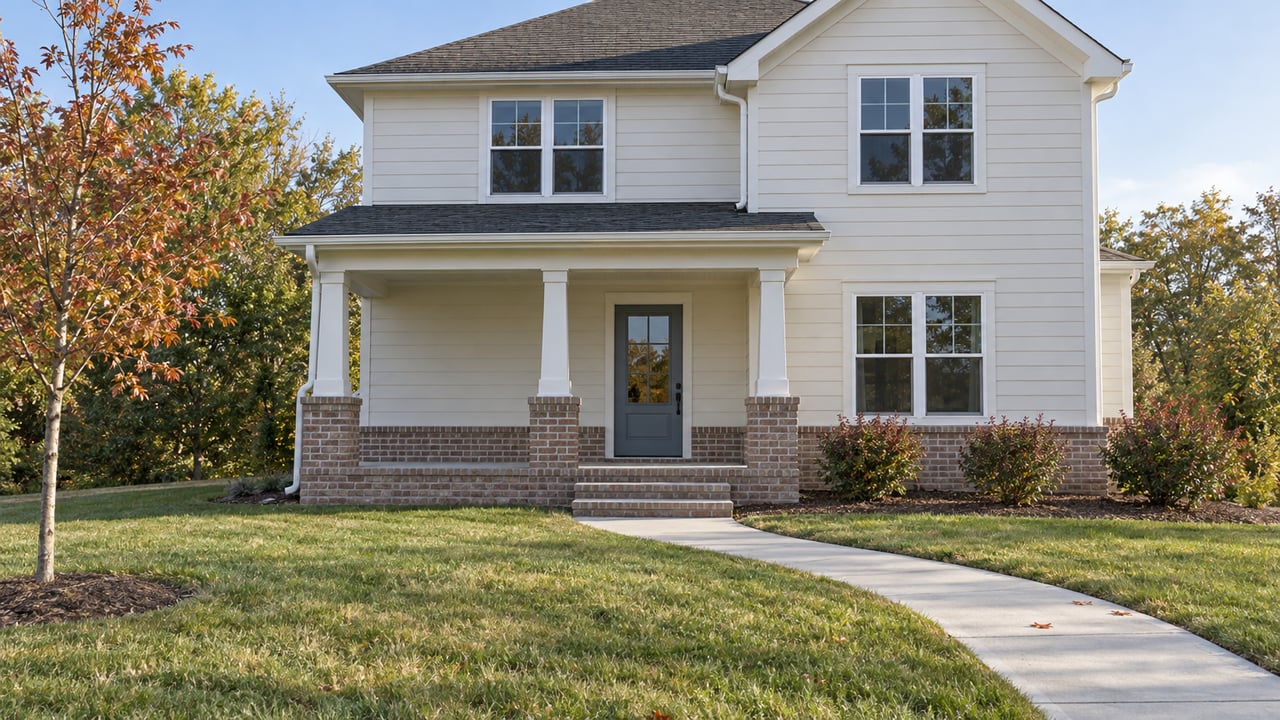
As of mid-October, the Rowland's Grant community page still opens with a banner offering "up to $40,000 to use as you choose." Ashton Woods' own fine print tells a narrower story. To get that money, a buyer had to write a contract between September 29 and October 7, 2026, and close by November 1. The offer covered only select quick move-in homes, and the buyer had to finance through Trailblazer Mortgage, the builder's affiliated lender. So by the time you read this, the contract window on that banner has closed.
On new construction in Fuquay-Varina this fall, most of the real discount isn't in the list price. It sits in the financing, it usually comes through the builder's own mortgage company, and it's often one budget you get to spend once.
One budget, several ways to spend it
D.R. Horton's Eagle Creek is the clearest example in town. The community page shows seven homes for sale. Several carry crossed-out prices, including 164 Gilmer Street, a four-bedroom, 2,662-square-foot two-story listed at $435,590, down from $514,495. On Greenwillow Drive, number 18 is listed at $475,190, down from $520,485. That's about $78,900 off one home and $45,300 off the other.
Below the listings, the financing offers stack up. Here's what the 164 Gilmer Street page advertised as of mid-October 2026:
| Offer | Rate | Window | What it requires |
|---|---|---|---|
| Special rate, FHA | 4.99%, 5.697% APR | Contract on or after Oct. 5, close by Dec. 31, 2026 | 3.5% down, DHI Mortgage financing |
| Special rate, conventional | 5.50%, 5.939% APR | Contract on or after Oct. 5, close by Dec. 31, 2026 | 5% down, DHI Mortgage financing |
| 2/1 buydown, FHA | 2.99% year one, 3.99% year two, 4.99% years 3 to 30 | Contract on or after Sept. 25, close by Nov. 30, 2026 | 0.375% discount point, DHI Mortgage financing |
The fine print on the buydown is where the trade-offs show up. D.R. Horton puts $7,258.44 in incentive funds toward the temporary buydown, and the disclosure says the buyer can use that money for closing costs or for the buydown. You pick one. The page also says the special rates may not be combinable with other D.R. Horton offers, and that a buyer doesn't have to finance through DHI Mortgage to buy the home but does have to use DHI to get the advertised rate.
Ashton Woods wrote the same rule more bluntly. Its flex savings could go toward price, closing costs, prepaids, a rate buydown, design studio options or appliances. The promotion was "not available with any other promotion, offer or negotiation." If you took the package, you couldn't also negotiate the price down.
So the crossed-out price, the rate and the closing credit aren't three separate wins you can stack. They're three uses for the same pool of builder money, and most of that money only flows through the builder's lender.
Why a builder would rather lower your rate than its price
For the week of October 15, 2026, Freddie Mac's Primary Mortgage Market Survey put the average 30-year fixed rate at 7.40%. D.R. Horton's conventional offer in Eagle Creek is 1.90 points below that, and the FHA offer is 2.41 points below. The national average is a benchmark, not a quote for any one borrower, but the gap is still big.
Here's what that gap means in dollars, using the builder's own conventional example of a $335,340 loan. Principal and interest at 5.50% come to roughly $1,904 a month. At 7.40%, it's roughly $2,322. To get the same $1,904 payment at 7.40%, the loan would have to shrink to about $275,000. In monthly terms, the rate offer works like a price cut of roughly $60,000. That's approximate math on principal and interest only, before taxes, insurance and mortgage insurance.
A builder can afford to do this because of how the rate is set up. D.R. Horton's disclosure says the company "has locked-in, through DHIM, a fixed interest rate for a pool of funds," and the rates last only until that pool runs out or the rate expires. Its third-quarter investor presentation says the captive mortgage company uses forward commitments to offer lower rates. In the 12 months ended June 30, 2026, DHI Mortgage financed 68,732 of D.R. Horton's 84,655 homebuilding closings, an 81% capture rate.
The company has also said it expects these incentives to continue. In its July 21, 2026 earnings release, D.R. Horton said it was balancing pace, price, incentives and inventory, and that it expected sales incentives to stay elevated in its fourth quarter as affordability and consumer caution weighed on demand.
Lennar, which doesn't build in the communities above, described the same logic. Its September 16 release reported sales incentives of about 12% in its third quarter, on an average delivered price of $372,000. On Lennar's third-quarter earnings call, management said its buydowns and closing-cost help are aimed at buyers who qualify on monthly payment, and that its 83% mortgage capture rate is how those programs run.
That's the reason behind the pattern. When most buyers qualify on a monthly payment, a dollar spent on the rate goes further than a dollar taken off the price. It also only reaches buyers who use the builder's lender.
Nationally, builders are now cutting prices as well. The NAHB's October 2026 Housing Market Index found 43% of builders cut prices that month, the highest share in the 2020 to 2026 period, with an average cut of 6%. Another 65% used sales incentives, the 19th straight month above 60%. Builder sentiment fell to 29, its lowest reading since June 2012. Eagle Creek is doing both, with crossed-out prices on the listings and special rates in the disclosures.
What the crossed-out price means after closing
Every incentive-assisted sale also becomes a comparable that later appraisals have to account for.
Fannie Mae's Selling Guide section on comparable sales requires appraisers to adjust comparables that involved rate buydowns, closing-cost payments or other financing concessions, but only by the amount the market actually supports. It rejects automatic dollar-for-dollar deductions. A separate section on interested-party contributions counts many buydowns funded by a builder or its affiliated lender toward financing-concession limits, though the guide treats some arrangements differently, including certain standby commitments a builder sets up with a lender before any sales contract exists. Where the limits apply, anything over them can be treated as a sales concession and subtracted from the price for loan-to-value purposes.
For an Eagle Creek or Rowland's Grant buyer, this matters twice. It matters at purchase, when the appraisal has to support the contract price. And it matters later, when your own home's value is judged against neighbors who may have bought with a 4.99% rate built in. In a subdivision where incentives are routine, sale prices alone don't tell you much about value.
The broader market isn't putting pressure on builders to stop. The latest official monthly snapshot is statewide, not specific to Fuquay-Varina. The NC REALTORS® September 2026 housing report showed 5.93 months of inventory, closed sales down 11% from a year earlier, and a median price of $370,000, up 0.7%. Flat prices with fewer closings is the kind of market where builders keep paying for the payment instead of cutting the price.
Reading a Fuquay-Varina builder offer sheet
Rowland's Grant lists plans from $429,990 to $559,990, near I-540 and US-401, with Hilltop Needmore Town Park close by. Eagle Creek's crossed-out prices fall in a similar range. The list price alone won't tell you which home actually costs less. The offer documents will, if you read them in this order:
- The dates. Check the contract window and the close-by deadline against the date you'd sign. The $40,000 banner outlasted its window, and D.R. Horton's buydown and special rate have different close-by dates.
- The either/or clauses. Find out whether the incentive can go to the rate or closing costs, and whether taking it rules out negotiating the price.
- The lender requirement. In both builders' fine print, using the affiliated lender is optional for buying the home and required for getting the incentive. The CFPB's affiliated business arrangement rule covers written disclosure of the relationship and limits, with stated exceptions, when a buyer can be required to use a particular settlement provider. Ask the builder for its affiliated business disclosure, and have your lender or attorney explain how it applies to your deal.
- Temporary or permanent. A 2/1 buydown goes back to the full note rate in year three. Plan your budget on the year-three payment.
- The points. D.R. Horton's buydown requires a 0.375% discount point, and its special rates "may require borrower to pay points."
- A competing Loan Estimate. The CFPB's Loan Estimate guidance suggests getting several estimates for the same loan type and comparing monthly payment, origination charges, lender credits, cash to close, APR and total interest.
The offers in this post are as advertised in mid-October 2026. Builder terms change quickly, so confirm what's current with the sales office in writing. This post is general information, not legal, tax or financial advice. Your loan terms, eligibility and closing costs depend on your own situation, so review them with a licensed lender and the right professionals.
If you're weighing a builder's rate offer against a crossed-out price or a resale home in Fuquay-Varina, Tamara White can lay the offers side by side, calculate the year-three payment, and negotiate on your behalf before you sign. Schedule a free consultation and bring the offer sheet with you.